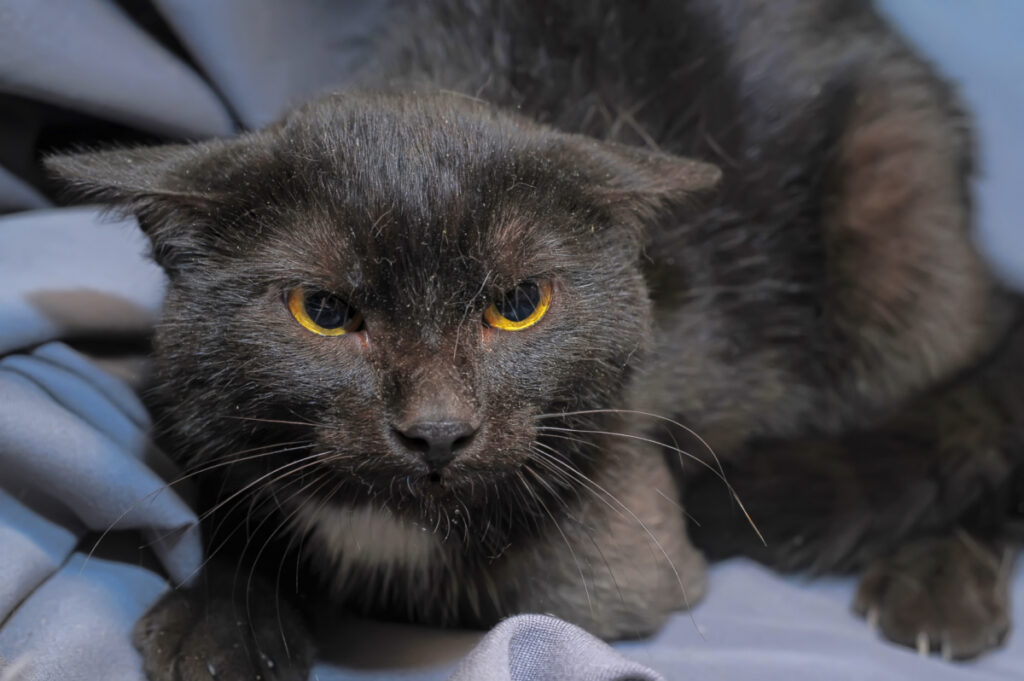
All rescuers have been there.
A new cat arrives at the shelter, scared, cowering in the back of the cage and hissing. He isn’t mean or vicious—he’s petrified prey trapped in a cage surrounded by hungry predators. Loud noises and overwhelming scents surround him. In his mind, it’s dinnertime, and he’s on the menu. So, the terrified tabby huddles in the back of the cage and hisses whenever anyone approaches.
In Fluffy’s mind, his growling and hissing are keeping him safe. But in reality, they’re doing exactly the opposite. A quick evaluation labels Fluffy as unsocialized and unadoptable. In a shelter full of confident, outgoing cats—and irresistible kittens—that fearful fluffball doesn’t stand a chance of finding a home. You know what that means.
A similar problem occurs in clinics, where even normally friendly and outgoing kitties become defensive.
So shelter workers, volunteers and veterinary nurses do what they’ve always done—what works at home when our own kitties are frightened: We pet them and speak comforting words, hoping they’ll relax and come out of their shells. It’s well intentioned; it feels right. But does it really work?
Not as well as you’d think, according to a 2020 study published in the Journal of Veterinary Behavior. The most effective approach wasn’t frequent check-ins or verbal reassurance, but one quiet, six-minute session of gentle petting per day—suggesting that silence, not pep talks, is the best strategy. (Where did they get these silent volunteers? I can’t pet a cat silently for six minutes. Can you?)
What Is Gentling?
Gentling isn’t taming. It’s calm, predictable human touch designed to lower fear and stress—without trying to force interaction, entertain, or audition the cat for adoptability. It won’t turn a feral cat into a love bunny, but it can help a frightened cat—one who is socialized but shut down—to relax enough to show his real personality.
One calm, quiet gentling session per day, lasting about 6–9 minutes, repeated over several days, worked best. Cats appeared more content and less stressed when interaction was calm, consistent, and, believe it or not, quiet.
After a few days of gentling, these cats spent more time at the front of the cage and on the floor, purred more, ate and drank more readily, and showed fewer stress-related behaviors—signs that they were calmer, more settled, and comfortable enough to be seen.
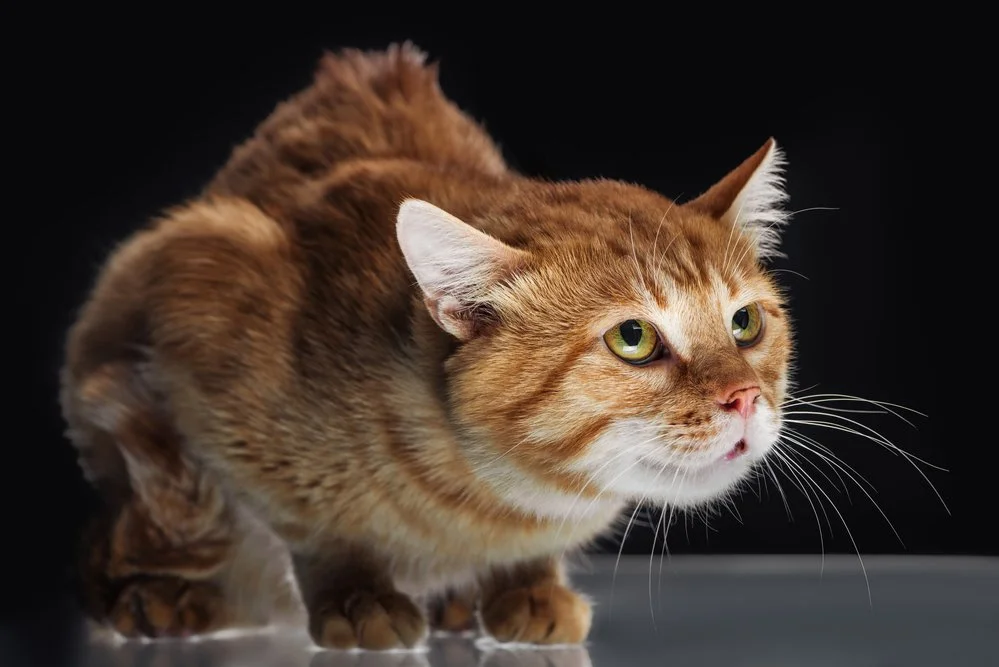
A stressed shelter cat huddled defensively—behavior often mistaken for aggression in noisy shelters and animal hospitals. Photo by Shutterstock.
Shelter Cats Are Thrust into a World That’s Too Loud
For a shelter cat, it’s:
- Strangers stopping, leaning forward and leering into the cage like a predator, talking, and moving on
- Too many smells
- Too many footsteps
- Barking dogs
- Cage doors slamming
- Loud voices
- Rooms that echo
Even when nothing bad happens, it’s overwhelming. For cats, that constant sensory overload pushes them into self-protection mode, which doesn’t help their adoption possibilities.
When a Cat Hides
In the study, cats were housed individually in cages with a large shelf at the back, a smaller shelf near the front, and a separate enclosed litter area. Where cats chose to spend their time mattered.
The back shelf is where cats retreat when they feel overwhelmed. The floor and front of the cage are where cats go when things feel manageable.
Gentling doesn’t force cats forward. It makes the environment quiet enough that they choose to come forward.
Experiment 1: One Long Session Beats Several Short Ones
In the first experiment, cats were gentled for five days in one of two ways:
• One continuous 6-minute session per day
• Three shorter 2-minute sessions per day
Each method was tested with and without human vocalizations.
The clear winner was one uninterrupted 6-minute session without talking.
Cats gentled this way spent significantly more time at the front of the cage afterward—an indication that their internal alarm systems had dialed down enough for curiosity to replace caution.
Adding human vocalizations raised the volume again. Cats exposed to talking during gentling were more likely to retreat to the litter area. The interaction stopped being calming and started being intrusive.
Experiment 2: How Much Time Is Enough?
The second experiment tested gentling durations of 0, 3, 6, and 9 minutes per day.
As gentling time increased, cats spent more time on the cage floor, purring more and even eating and drinking more—behaviors associated with being calmer. The sweet spot appeared to be 6 to 9 minutes per day. Three minutes wasn’t long enough to quiet the background noise.
When the volume comes down, cats move forward. They become visible. They linger instead of disappearing to the back of the cage.
The Takeaway
Gentling isn’t about convincing a cat to like people. It’s about creating a pocket of quiet in a loud place.
Six to nine minutes of calm, silent contact over several days allows cats to regulate themselves enough to show their truer self. That’s what adopters want to see.
Lower the volume, and the cat does the rest.
Calm kitties are much cuter anyway.
Yes, they are. Although there are few things funnier than a kitten with newly opened eyes hissing at you.
World is too loud for me. Can’t imagine what cats hear.
You’re right. And shelters are always noisy.
Dusty is the best advocate that cats, any and all, could hope to have. I personally have 3, and 3 dogs as well. Trust her insights because she really cares.
Thank you, Beth. They are intriguing little creatures.